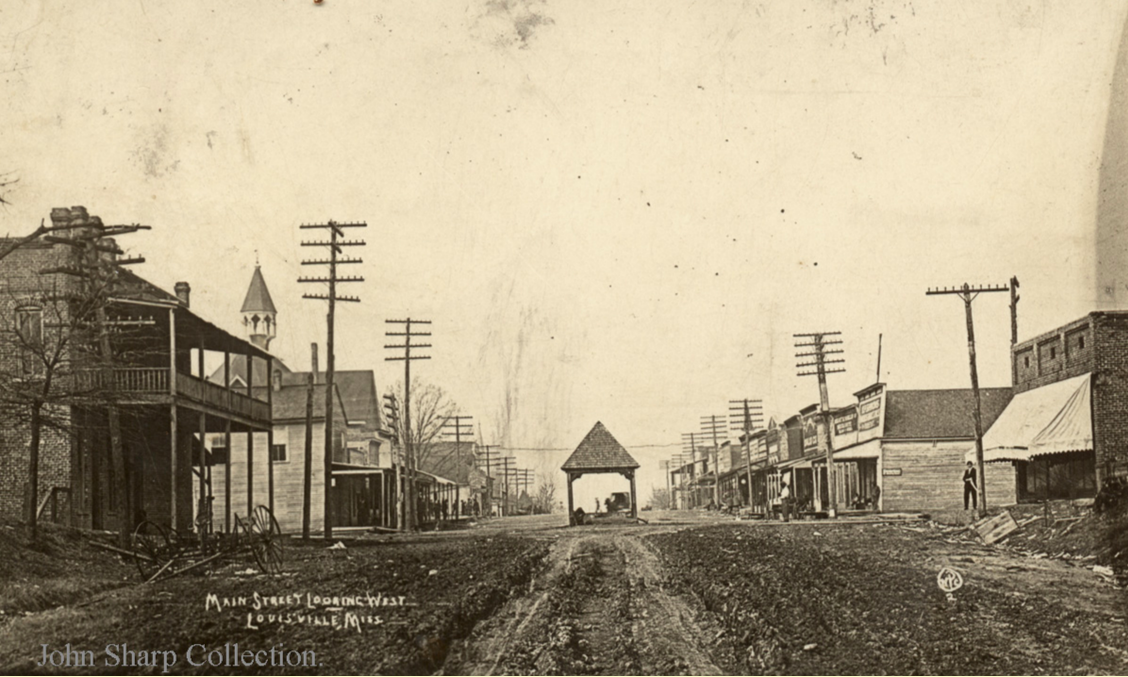
I moved to Louisville, Mississippi…to the red clay hills of Central, Eastern Mississippi when I was 11 years old. My mom was born there, above the Strand Theater, like so many others from that town. Later I would realize that I was 7th generation Louisville, Mississippi on my mother’s side.
My mom left Louisville at three years old. Her father, a WWII veteran, left the farm life and had been recruited to manage department stores. They moved from North Carolina to Virginia to Florida and then to New Orleans, Louisiana. There, in the streetcar sounds of New Orleans, my mother would come of age and go to university…a full-ride scholarship to Loyola’s respected music school.
At Loyola, my mother would meet my 5th generation New Orleans father. My father would eventually be hired by the Presidential Marine Band and hence, their move to Washington DC. That is where I was born. And, I was there until 6 years old, when my parents divorced.
My mom would pack her station wagon with our things, her two daughters 6 and 9 years old, and our dog and cat, and somehow drive from Washington DC to New Orleans. There she would work 2-3 jobs to pay the bills until she landed a single job at a good private school teaching theater and musc. We lived in New Orleans for about 4 years and then my mother remarried.
Like a boomerang, she found herself back in Louisville, Mississippi with that marriage. Grandmother was across the street. My cousin lived across the street. We were renting from another cousin. And, a Great Aunt lived down the road. I went from being no one, nowhere, to seemingly everyone knowing my grandmother or my cousin or someone I was kin to.
I went from only playing inside the safe confines of my home in New Orleans, to playing outside until it got dark with my neighborhood friends in small town Mississippi. We went from a struggling mom with two kids type of situation to a rather stable family situation.
It came with a price. There were expectations on behavior that were new to me like saying ‘Yes Ma’am’ and ‘No Sir.’ And, the Presbyterian Church I went to taught me of the evils of unsavory games and rock and roll, so I dutifully tossed my cassette tapes and typical New Orleans Ouija board in a trash bag and shoved it into the trash can.
Devil can’t catch me now, I thought!
I was learning what was good and what was evil. And this, I discovered, was a big preoccupation of Southerners. You know — being able to identify evil things and casting them out of your life.
I remember one of my grandmother’s friends. She made me nervous but my grandmother always gave me that look that said, ‘just comply.’ So, if this friend of grandma’s was around, I stood there dutifully and she grabbed me in a bear hug and then prayed fiercely over me, for my protection. I don’t recall anything she said as I was always so overwhelmed by the experience. Ironically, I was silently praying for my release.
When she did let me loose, I would take a big inhale and take some steps back so that I wasn’t sucked into her vortex again. I learned to be polite even when I was uncomfortable.
As an adult, I realize the shortcomings of such training and now vocalize my disapproval in similar situations. I mean, no one is grabbing me to pray over me these days, but some people come on strong like a measureable yet determined tornado. I have learned to disappear into the shrubbery until they pass.
When I moved to Mississippi at 11 years old, I didn’t realize how long my people had been there. I didn’t realize that they moved in when the Choctaw and the Chickasaw were moved off their land. Years later, during genealogy research, I start seeing my people’s names in the 1830s and 1840s census records.
The so-called Treaty of Dancing Rabbit Creek was signed just 30 miles Southeast of Louisville (just south of Mashulaville) in 1831, ceding the land of the Choctaw to the United States. In 1832, the so-called Treaty of Pontotoc Creek was penned just 80 miles or so north of Louisville which ceded Chickasaw land to the United States. Louisville is located in Winston County which lies about 30 miles south of where the northern reaches of Choctaw territory met with the southern reaches of the Chickasaw territory.
It was in the hollow echoes of these two treaties that land was opened up for land hungry settlers who were looking for opportunities. These were my ancestors. Most of these settlers traveled over generations from colonial Virginia, North Carolina, and South Carolina either through the Cumberland Gap where Tennessee, Virginia, and Kentucky converge in the mountains or they came over the lowlands of Georgia and Alabama.
It’s interesting to note that my mother’s paternal side were largely those who went through the Cumberland Gap and the mountains. On my mother’s maternal side, they were largely cohorts of families that went the lowland route through Georgia and Alabama.
Growing up in that small town, I came to think that porches were typical, as well as sweet tea and lemon ice box pie. My DC and New Orleans accent steadily took on the drawl that was surely a result of the wet heat of Mississippi but also likely from the dreaded hookworm which plagued the South in the 19th century.
In public school, my non-Southern-talking-self was called a Yankee. I didn’t realize at the time that that was the worst thing a person could be called in a Southern state. Luckily, my ignorance of the Civil War graced me with enough time to shift from saying hog to haaaawwwwg. I learned to drawl my vowels and was the perfect Southern specimen in under a year’s time.
I adapted to survive.
I thought the paddlings at school were normal, too. One teacher had holes cut in her wooden paddle so that the air friction did not slow it down as it reached for your remorseful hind quarters. That was Ms. Nathan the P.E teacher.
The crime? We had been yelling at the back of the bus.
About 20 of us lined up to get paddled that day. I smartly found myself at the back of the line. When it was my turn, I looked at Ms. Nathan, a black woman fueled with sufficient lung capacity to yell across the school at any time, and she looked at me. She said in a voice full of huff, ‘you think I’m tired, don’t ya? Well, I’m not…I’m just gettin’ warmed up. Bend over.’
My mother didn’t even know I was paddled at school until well after high school graduation. I just thought it was normal for middle school. Now, in the state of Mississippi, your parents have to sign a form giving teachers permission to paddle you if necessary. And, some parents do.
Needless to say, arriving in Mississippi was a mixed bag of relief and torture.
Can they exist all at once, you may ask? They can in Mississippi.
My reality shifted from jazz, Mardi Gras, beignets, and bayou to red clay hills, fried apple pies, church choir, and the Neshoba County Fair (a nearby county fair that was so prolific that it absorbed bystanders from other surrounding counties; it was established in 1889 and is the nation’s longest running campground fair). Yes, in 1988 I had come home. I had come to the historical mess of a home that was small-town Mississippi.
This is a place, I am convinced, that my ancestors selected to be left alone, once and for all. I mean. Why else would they push on through the hustle and bustle of boom-towns like Tuscaloosa, Alabama? I think it was to get their land, get away from the pushing and shoving, and to finally put their stake down.
I have to think about at what cost they did so. They must have known that they were moving onto tribal lands. Where they so desperate that they did not care? If Natives were hiding from authorities, did they out them or absorb them into their communities?
On that note, I have been told that the Bevill Hill area of Louisville was a very mixed community. That would be the place that my melungeon GG grandmother, Betty Taylor (born 1835) had moved to with her husband, a recent Scot-Irish immigrant from North Ireland. Out of my mother’s family lineages, this Scot-Irish immigrant was my most recent ‘new arrival immigrant.’ Interestingly enough, he fought with the Confederates in the Civil War and married Betty Taylor, visibly of mixed race (Native, European, and African). She is my ancestor with the deepest roots in this country, having Native ancestry.
I remember speaking with someone who had worked at the local wildlife refuge and was a descendant of early Bevill Hill settlers. He told me that lots of Natives lived in that area of Winston County as it was remote and the community had more mixed families. These are people who had escaped removal and were living on the periphery of main town centers. Such was the case of my Betty Taylor who was mixed but always indicated that she was ‘W’ or white on census records.
If you were identified as black, you would lose your land…well, that is, until slavery was abolished (and it was still extremely hard for blacks to secure land even after that time in the 1860s). If you were Native, you did not have the legal right to own land. Thus, the ‘W’ descriptor was claimed by anyone remotely ‘white-passing’ or mixed so that they could own land, stay in their marriage, and/or escape removal. Such realities make it very difficult to research melungeon ancestors who existed in multiple worlds to survive.
However, Betty Taylor’s Native ancestry is likely from the mountains or coast. She was not Choctaw or Chickasaw. Most likely, she was Cherokee or Catawba. That part I am still figuring out. In the portrait I have of her, I notice her eyes that have seen too much… I see her simple farm dress, her ears adorned with beaded earrings, and her neck adorned with a beaded necklace.
When I look at her picture, I often wonder what she would say. I wonder what her stories would be. She had a foot in every door, so I wonder where she stood. Out of all of my ancestors, I have researched her the most…hoping to understand her…hoping to catch a glimpse of what her life was like. What lullaby did she sing to her children at night? What foods did she prepare? What kind of conversations did she have with her husband, with his thick Scot-Irish accent in those red clay hills of Central, Eastern Mississippi with the droning sound of cicadas and katydids in the background?
When I visit my mother in Mississippi, I am overwhelmed with stories. They emerge from the sleepy, Southern surroundings as if I’m reading the land like a book. When I’m driving, it’s like someone is turning the pages of the book feverishly…and I only see fragments of sentences flashing across the page.
The daffodils by an old farmstead. The Native mounds, surviving in farm fields. The Civil War reenactments. Faulkner quotes. Bible versus. Pecan orchards. Pulp wood trucks (pronounced ‘pup wood’). A picture of Jesus next to Elvis; apparently, the two sons of God, and, arguably, the two faces of Mississippi. One washes away our sins, and the other reminds us that dancing doesn’t make us the devil after all.
 Lindsay Kolasa