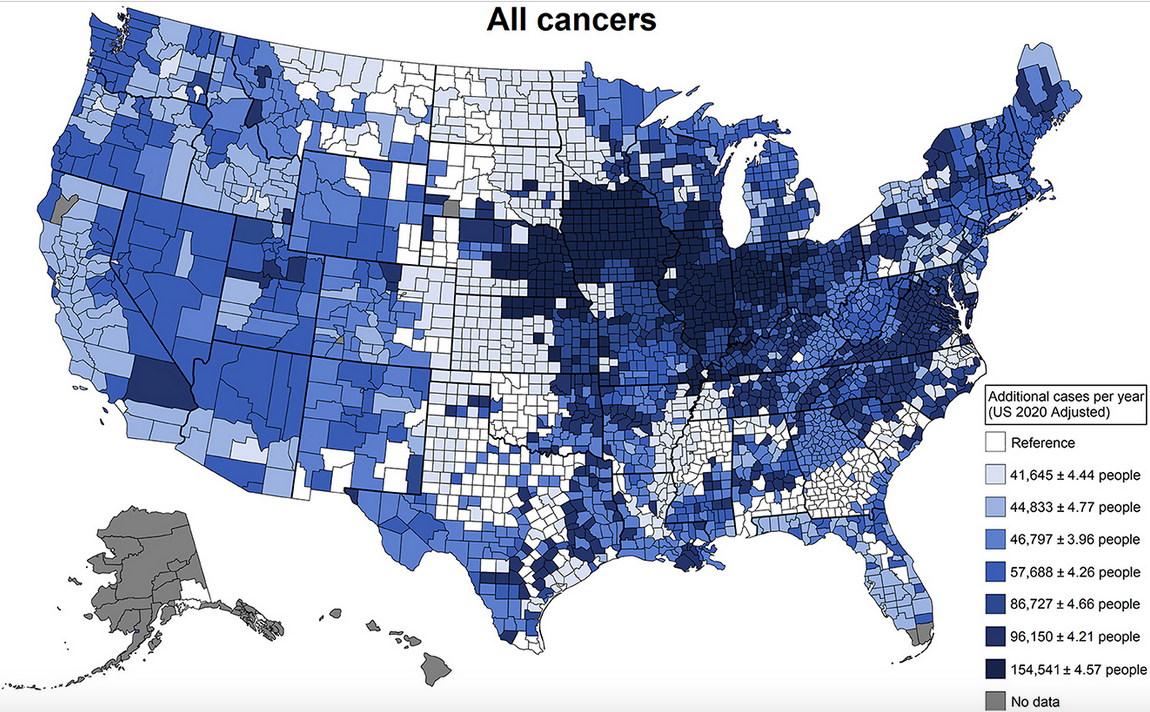
Caption for this picture from the original scientific paper – “Additional cancer cases in a single year that can be attributed to differences in agricultural pesticide use patterns. These patterns of use were defined by latent class analysis; estimates were derived from generalized linear models adjusted for agricultural land use, total population, the Social Vulnerability Index, and smoking rates. This plot contrasts the counties that have the least risky use of agricultural pesticides with the counties that have the riskiest use of agricultural pesticides.”
I REALLY DON’T WANT to be naming a blog post of mine with this title. I really don’t want to be writing about this, but here we are…and here I am. This study, published in July 2024, concluded that pesticide exposure ‘may rival smoking’ in terms of cancer incidence in a population.
Just looking at this map, I can see the outline of the corn-belt. I can see the cotton and soy country of the Mississippi Delta. I can see Virginia, the place where the first English colony would take root, saddled with the weight of pesticide use to grow tobacco.
This is not the America my ancestors worked so hard to become a part of. This is not the America I want for my daughter or for any child coming of age.
There are many pesticides, herbicides, and fungicides that are being used throughout the US. Glyphosate (RoundUp) is one of them. Patented as an agricultural antibiotic, this pesticide is routinely used as a desiccant for crops like grains and legumes. As a desiccant, it hardens the seed for easier harvest.
Glyphosate is also suspected as microbiome disruptor, leading a number of people who have been exposed to glyphosate to become diagnosed with Celiac Disease. Glyphosate does this by disrupting the microbiome in the digestive tract, making the mucosal layer of the digestive tract inflamed and permeable. Considering that glyphosate was patented as an antibiotic, this would make sense.
It is said that hunter-gatherers have around 2000 unique microbes in their digestive tract whereas modern humans have about 200 unique microbes. TWO HUNDRED! We humans are experiencing GI microbes that are going extinct!
As a society, modern humans do not need to continue to fight, suppress, or dominate the unseen realm of these bacteria. We need to learn to work with them. We should be tripling down on all research that supports their microscopic cultivation in our gardens, on farms, in the field, and in our own bodies.
The overuse of antibiotics in our medical system is resulting in allergic reactions to antibiotics in adults and children. The overuse of pesticides on the great land of the US is resulting in inert soil instead of living soil and polluted waters losing their biodiversity as run-off from farms enter their banks.
Not only do we have to be concerned with Celiac Disease, increased allergies, dysregulated immune function, and systemic inflammation…we have to realize that pesticide exposure leads to cancer, period. Referring back to the study I posted on pesticide exposure in the US, this should sound the alarm bell for everyone. Children are getting cancer for crying out loud!!!
We have many movements afoot in the real food world that can correct this: an emphasis on small and medium sized farms, bio-char, permaculture, regenerative agriculture, organic agriculture, forest farming, Traditional Ecological Knowledge (TEK), and more. We have to support our farmers in making those necessary transitions.
I want my daughter to play in creeks. I don’t want to be concerned about pesticide exposure or forever chemicals in the creek. I don’t want the salamanders to die. I don’t want the frogs to die. I don’t want the fresh water muscles to vanish. I don’t want the fish to die.
I want our watersheds to be treated with respect. I want the methods we use for farming to be life-giving, resourceful, and brilliant.
But, instead of shifting gears to better practices on agricultural land, it seems that the pesticide companies (like Bayer) are trying to shield themselves from any liability for any possible damage done by their products. Currently, they are lobbying in small agriculture states for legislatures to enact a bill on the state level to protect them from any liability (couching it as a bill that is good for farmers).
In my home state of Mississippi, there is a bill in the senate committee (SB 2472) that is up for a vote. They are working in Idaho, Iowa, Wyoming (although, I think the Wyoming bill did die in committee!), and a dozen other states. There is rumor that they are pushing for a Federal bill in March which must not happen.
These pesticide companies must be held accountable. Please make sure you check with your local legislators and ensure that no bill like this will be successful in your area.
Senator Booker introduced a bill (S 269) in Congress in 2023 called ‘Protect America’s Children from Toxic Pesticides Act,’ but there is no update on the status of that bill. This is the kind of legislature we should be pushing forward as we fight the bills surfacing on the state level to protect pesticide companies.
May the watersheds be pure.
May the soil be life-giving.
May the air be clean.
May we have a sense of dignity in our bodies.
May we cultivate real nourishment.
May we do what is right for future generations and for all life.
Silent Spring by Rachel Carson was published back in 1962. We’ve had 60 years to get our act together and matters have only gotten worse. This is the most important work of our lives, in my opinion…to finally create right relationship with the soil and the water that we rely on.
We must do this.
 Lindsay Kolasa
Thank you for such an informative post, Lindsay. My husband, who developed celiac fifteen years ago, grew up just outside Hannibal, MO, on the banks of the Mississippi River. I’m now wondering if all his days playing in creeks nearby had an underside.
Vikki
I don’t doubt it… Also, air quality would have to be considered. Scientists are also finding pesticides and such in the rain, at rather high levels. There’s quite a bit of glyphosate in rainfall in the Southeast, for example.
Considering glyphosate’s effect on microbes, it shocks me at the damage it could be causing across vast tracks of land not even applied with this pesticide. Scientists have realized that even when a plant emerges from a seed…there are dozens upon dozens of microbes that specialize in populating each part of the plant as it appears from the seed.
Literally, everything on this planet is coated in microbes that specialize in processes we have only begun to understand.
I think it is incredibly important to stop these pesticide companies as swiftly and surely as possible. I can see a very narrow and specific application of a pesticide and herbicide in an acute situation…when all other options have been depleted…but not the broad use we are seeing right now.
Oh yes, and I also want to say that viruses and vaccines alike can lower the amount of microbial diversity in the GI as well. Sometimes an acute virus or vaccine administration has caused someone to develop Celiac.
However, this all leads back to lower microbial count in the GI and also the rise of zoonotic diseases…which is really a result of the over domestication of our environment (specifically animals). Tuberculosis is cattle derived…measles from horses…chicken pox…well, from chickens…and the list could go on and on.
I think over-domestication of animals plus the use of these pesticides is a very bad combination for human and planetary health.